Below are a series of diagrams that demonstrate how to calculate the area of two dimensional shapes.
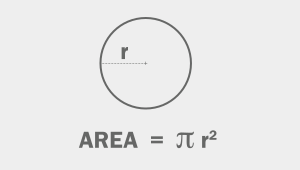
Area of a Circle
The area of a circle is the product of pi and the square of the radius.
Area = pi (r x r)
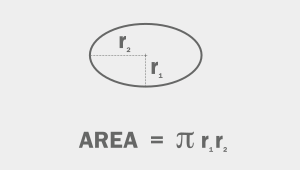
Area of a Ellipse
An ellipse is flattened circle so the area calculation takes into account that there are two different radii.
Area = pi (r1 x r2)
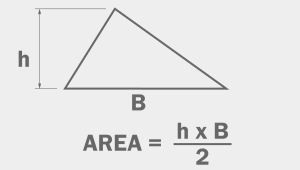
Area of a Triangle
The area of a triangle is half of the product of the base and height.
Area = (h x B)/2
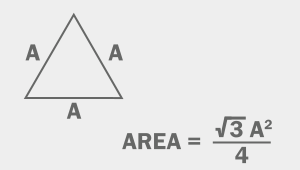
Area of an Equilateral Triangle
An equilateral triangle has 3 equal length sides. While the formula above will also work, there is an alternative method of calculating the area of an equilateral triangle.
Area = ((sqrt 3) (A x A)) / 4
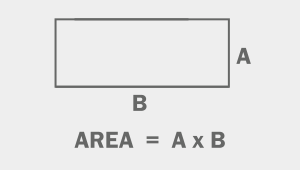
Area of a Rectangle
The area of a rectangle is the product of the long side and the short side. The area of a square is the length of a side squared.
Area = A x B
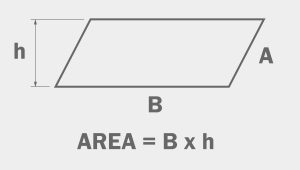
Area of a Parallelogram
A parallelogram is rectangle that is skewed slightly. The area is a product of the base and the overall height.
Area = B x h
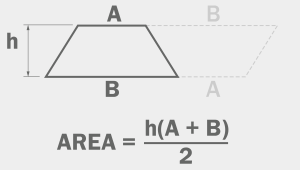
Area of a Trapezoid
Trapezoids are half of a parallelogram. The diagram at left shows how 2 equal trapezoids make a parallelogram. Therefore, the area calculation is simply half of the area of a parallelogram.
Area = 1/2 (h (A + B))
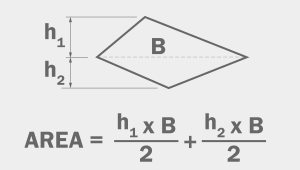
Area of a Quadrilateral
A quadrilateral is simply two triangles put together, so the area can be calculated by summing the areas of the two triangles.
Area - (1/2 (h1 x B)) + (1/2 (h2 x B))